Why we pay extra for "probably fine"
Most of the time, we don't chase the best result. We pay to make sure things don't go badly wrong.
I just read Alchemy by Rory Sutherland and one idea has been rattling around my head ever since.
Let's say you're buying a television. You walk into the shop (or, let's be honest, open a tab) and you end up paying extra for Samsung or Sony instead of the brand nobody has heard of. Why? Samsung isn't guaranteed to be the best television you could possibly buy. But, as Sutherland put it in an interview with the Irish Times, when you buy a Samsung, somewhere in your brain you're predicting it'll land between okay and very good. The no-name brand might be brilliant. It might also die the week after the warranty runs out, assuming it came with one.
Sutherland's claim is simple: most of the time we'll happily pay a premium to rule out the worst outcome, even if it means giving up a shot at the best one.
An economist would call that irrational. You're paying more for something that, on average, might be no better. Sutherland's point (and I agree with him) is that it's perfectly sensible. When you can't tell in advance how good something is, removing the chance of disaster is worth far more than a small chance of something slightly better. A slightly better TV makes you mildly happier. A TV that dies ruins your evening, your weekend and your relationship with the shop.
Don't get me wrong: sometimes people DO want the best. Enthusiasts, professionals, people who read TV reviews for fun (you know who you are). But most of us, most of the time, just want not to get burned.
Once you see it, it explains a lot. Take copying. Most of what we buy, wear and do, we do because other people did it first. That's the basis of fashion, and it's a big part of the engine of consumerism. It also makes sense: if plenty of people bought something, it's unlikely to be dreadful. The crowd isn't great at picking the best, but it's pretty good at weeding out the disasters.
Which brings me back to the television. Why Samsung and not the brand nobody has heard of? Because a brand is a kind of guarantee. More specifically, it's what's called a costly signal, and the best example I know has feathers.
Wait, what's a costly signal?
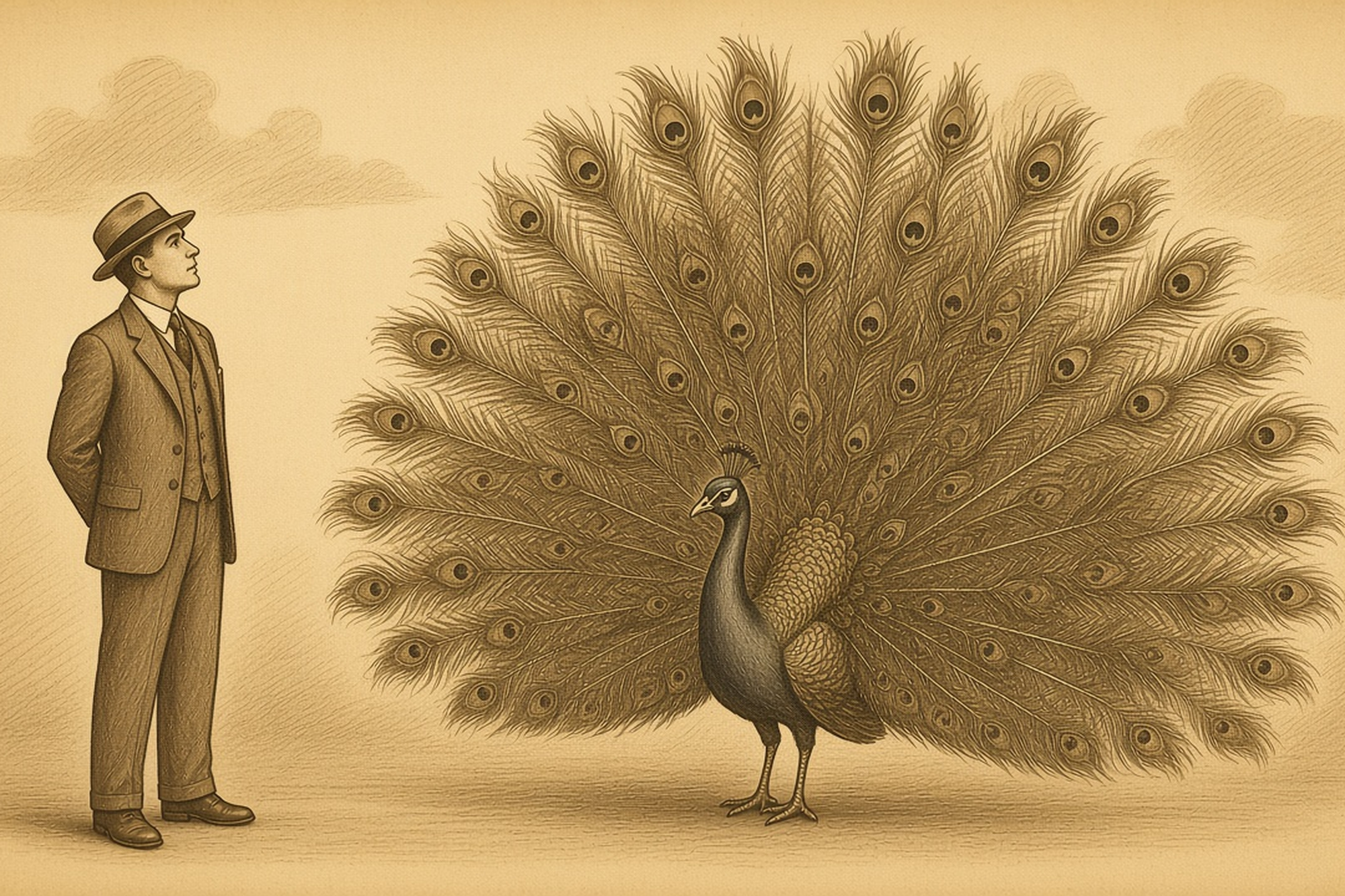
Take the peacock's tail. It's enormous, it's heavy, it takes a lot of energy to grow, and it makes the bird about as discreet as a fire engine. From a survival point of view it's a ridiculous thing to carry around, and that's exactly the point. A healthy, strong peacock can afford it and a weak one can't. So a peahen looking at a magnificent tail is looking at something a weak bird couldn't fake.
This is the handicap principle, proposed by the biologist Amotz Zahavi in 1975, and it's the classic example of a costly signal. (In fairness, some biologists now think Zahavi got the details wrong. The peacock has declined to comment.)
Here's the key point: what makes a signal convincing is that it costs far more to fake than to back up. For the healthy peacock, the tail is a burden he can carry. For the weak one it's a death sentence. It's the same tail, but the bill lands very differently.
Brands work the same way. Samsung has spent a fortune on advertising, shops, warranties and a reputation built over decades, and it would lose all of that if its televisions turned out to be rubbish. A no-name seller with a website and a nice photo has nothing to lose, so its promises cost it nothing. When you pay the premium, you're paying for the fact that the company has put its own neck on the line.
If this is right, the premium should be biggest where quality is hard to check before you buy, and smallest where it's easy. TVs are a good test. Independent measurements and detailed reviews have made picture quality much easier to judge in advance, and brands like TCL and Hisense have taken a big chunk of the market. In other words, the less you can check before you buy, the more a brand is worth.
So what's your tail?
If people are wired to avoid disaster, you don't win by shouting that you're the best. Everyone says that, and saying it costs nothing. You win by finding your equivalent of the peacock's tail and putting it front and centre.
The test is simple: what can you offer that's cheap for you because your product is good, and would sink a competitor whose product isn't?
- A guarantee. If your product works, a refund policy costs you almost nothing. If it doesn't, it'll bankrupt you, and that's exactly why customers believe it.
- A guarantee of results. This is the gold standard: "If you don't get X, we'll pay you back twice." Only a company that's very sure it delivers can afford to say that. A faker who tried it would be out of business in a month.
- Track record. Years of visible history can't be faked overnight.
Notice what's not on the list. Free trials don't make the cut: software is so cheap to produce that a trial costs a faker about as much as it costs you. Reviews don't either, because they're cheap to fake, and that's precisely the problem with them.
Whatever your tail turns out to be, it belongs in the headline and the pitch, not buried in the small print. Peacocks keep their tail tall and proud.
And when you're the one paying extra for a brand, flip it around and ask what the company would lose if the product turned out to be rubbish. If the answer is "not much", you're paying for a tail that isn't there.
Next time you write a sales page, ask one question: what could I promise that a worse competitor couldn't afford to?